Supplier account management: what are the impacts on cash flow?
Amber Baynaud
Oct 18, 2024

The management of accounts payable and the optimization of cash flow are two closely related subjects. Today, the objective of all businesses is to ensure their financial health. But what does this mean?
The financial health of a company is reflected in the state of its cash flow, that is to say, the amount of all liquidities immediately available that allow it to meet its financial obligations. This cash flow requires relevant and precise overall management to be optimized.
The overall management of a company relies on the management of different sectors. In this article, we will focus on the management of accounts payable. This represents how an organization will manage its relationships with its suppliers. It is an essential component in the process of optimizing the company's value chain and will therefore have a significant influence on the state of the final cash flow.
What is the role of accounts payable?
Accounts payable plays a true strategic role in the sustainability of a company.
What is accounts payable?
It is much more than a simple list of creditors and primarily represents a process that includes both contracts with suppliers, payment terms, and debts to be paid. Accounts payable corresponds to how the company will manage its relationships with all its business partners on which it depends, whether for raw materials, products, or services. When the management of this account is effective, the fluidity of the supply chain is guaranteed: goods are delivered, and payments are made, avoiding potential disputes.
Accounts payable is comprised of various elements. We can identify the number and diversity of suppliers, payment terms, negotiations, supplier debts, stock volume, and working capital.
What are the challenges of accounts payable?
Accounts payable represents for companies a significant number of challenges they must face to maintain sufficient cash flow.
Negotiation with suppliers
The business relationship maintained between a company and its suppliers is accompanied by a trust bond. Delivering goods means receiving payment in return, although this is not immediate and depends on the payment terms established.
The capping of these payment terms is set by the commercial code.
Unless agreed otherwise between the parties, the payment term is set at 30 days from the date the goods are received or the service is performed.
The agreed term between the parties cannot exceed 60 days from the date of the invoice issuance.
By way of exception, a maximum term of 5 days at the end of the month from the date of invoice issuance can be agreed upon by a contract between the parties.
In the case of periodic invoices, the agreed term cannot exceed 45 days from the date of invoice issuance.
Many companies tend to negotiate longer payment terms with their suppliers to optimize their final cash flow. The goal is to collect customer receivables before settling supplier debts. This approach, although widely used, has some drawbacks. First, there is potential deterioration of the relationship that the company has with its suppliers, which can be due to repeated and abusive negotiations or failure to comply with the established terms. Additionally, this method leads to an inability for the company to have a clear view of its actual cash flow.
However, although this method of deferring payment terms to suppliers may have some drawbacks, don’t hesitate to implement it as soon as you encounter cash flow problems and are unsure if you will be able to honor your debts. You will thus be able to time your payments carefully without taking risks with your cash flow.
Mastering negotiations with suppliers, of which payment terms are an integral part, is therefore essential for a company. This guarantees a reliable representation of actual cash flow and, obviously, preserves the business relationship.
Working capital
Working capital is a financial indicator that informs on the company's capacity to meet its long-term commitments without resorting to borrowing. Its measurement reflects the financial health of the company and evaluates whether it will be able to support its operations and invest in the future.
Working capital can be calculated in three different ways:
The first is based on the top of the balance sheet:
Working capital = Permanent capital - Fixed assets
The second is based on the bottom of the balance sheet
Working capital = Current assets - Short-term debts
The third is a bit more detailed:
Working capital = Stable resources from the top of the balance sheet (capital, results, debts + provisions for charges) - Gross fixed assets
These different calculations will lead to three possible interpretations depending on the result obtained.
Working capital is greater than 0. This means that the company is in good financial health: its long-term investments and current expenditures are covered by the resources.
Working capital is equal to 0. This means that the company has sufficient resources to finance its long-term investments, but not enough to cover its current expenses.
Working capital is less than 0. This means that the company does not have enough resources to finance its investments: it finances its fixed assets with short-term debts, which could jeopardize future financing of its current expenses.
Good management of accounts payable will favor the company’s financial resources. This will have a positive impact on the result of its working capital, which could even contribute to a positive working capital, and thus to the company’s solvency.
Stock volume
Having a sufficient stock volume means that the company is capable of delivering the product or executing the service immediately. This also means good cash flow: a company that experiences poor stock management may find itself overstocked, which could lead to additional costs.
Good management of accounts payable involves good stock management: a company must be able to satisfy its customers' demands. It is necessary for it to anticipate demand and adjust its supply as closely as possible to avoid both overstocking and stockouts. Therefore, it is essential to monitor the stock rotation of each of its products.
Moreover, storing goods generally costs the company because the working capital is directly impacted.
To ensure this management of stocks and a sufficient stock volume to meet demand, it is crucial for a company to establish regular stock monitoring.
Why is managing accounts payable important for the financial health of the company?
The way a company manages its relationships with its suppliers will have immediate consequences on its overall performance. When relationships with partners are well managed, this often translates into good communication, consistent quality of delivered products or performed services, increased reactivity to market fluctuations, negotiation possibilities, as well as beneficial payment conditions.
On the other hand, when management is not rigorous, this can lead to stockouts, unexpected additional costs due to emergency orders, for instance, or even a deterioration of the company's reputation.
For these various reasons, managing accounts payable is important and can, in addition to guaranteeing financial and operational stability, become a source of performance that elevates the company towards its success.
Supplier debts: their impact on cash flow
What is a supplier debt?
Supplier debts correspond to the obligation for a company to pay its suppliers. It is the existing balance on a contract established between a company and a supplier, representing the amount for a certain number of products or services still unpaid. The company will receive an invoice showing this amount that it will be obligated to pay within a timeframe pre-established with the supplier. Suppliers may grant payment terms that are longer or shorter to companies, thus providing them with additional time to have enough funds to make this disbursement. All of these contracted debts will be grouped under liabilities in the accounting balance sheet.
Supplier debts are frequently used to finance the company and represent an important financial resource (since they have not yet been paid).
It is important to always monitor the evolution of these supplier debts to avoid significant discrepancies relative to cash flow. This monitoring would lead to decisions regarding payment deadlines, for instance, to better optimize cash flow.
Their impact on cash flow
As we have mentioned, supplier debts influence a company’s cash flow and represent a significant financial resource. Today, many companies seek to extend their payment terms to have this financial resource available for as long as possible.
High supplier debts can reflect not only a high level of trust from business partners towards the company in question but also a reduction in the need for working capital.
Optimize working capital with accounts payable management
What is the need for working capital?
The need for working capital (or NWC) is an indicator representing a company's short-term financing needs. It is the amount needed for companies to cover their current expenses while awaiting payment from their customers.
The NWC reflects the financial autonomy of the company: if a company is capable of financing its expenses before receiving payment from its customers, then it is financially autonomous.
To calculate it, the NWC has two calculation formulas: one simplified and one extended.
Simplified formula
Need for working capital = Receivables + Stocks - Debts (all non-financial debts)
Extended formula
Need for working capital = Operating uses - Operating resources
We can interpret three possible results:
The NWC is positive: Operating uses are greater than operating resources. This means that the company has a need for financing for some of its uses. It will have to finance them with its working capital or through its financial debts.
The NWC is zero: Operating uses are covered by operating resources. The company does not have a financing need but also has no financial surplus.
The NWC is negative: Operating uses are fully covered by operating resources. The company has no financial need and will even generate a surplus that will increase the balance of its net cash flow.
Also read: What is a cash need?
How could accounts payable management optimize the NWC?
Most of the time, when a company has a positive NWC, it is when its payment terms established with its suppliers are shorter than its payment terms with its customers: it must disburse money that it has not yet received.
In the opposite situation, when the NWC is negative, it is said that companies have resources in working capital. This means that the payment terms with suppliers are longer than those with customers. This is often the case in the retail sector, where customers pay cash.
In order to optimize the NWC, it is feasible to better manage accounts payable. It is possible, for instance, to:
Negotiate the payment terms established with suppliers. This would allow the company to have enough leeway to generate value before making any payment.
Avoid early payments as much as possible.
Select suppliers whose delivery terms are the shortest. It is important that the company’s activities can continue and intensify to generate maximum value while awaiting to pay suppliers.
Optimize order placements: ensure not to place all orders at once to avoid being overwhelmed by supplier invoices.
Do not anticipate payment to suppliers to obtain discounts.
The need for working capital can be significantly optimized through good accounts payable management within the company, the goal being to ensure the financial health of the company in the short, medium, and long term.
The risks of ineffective accounts payable management
Ineffective accounts payable management exposes the company to multiple risks that can be financial, strategic, or even operational.
Payment delays
One of the risks arising from ineffective accounts payable management is payment delays. Delays, when prolonged repeatedly or for too long, can have an impact both on suppliers and on the company.
The risk for suppliers, especially for small businesses lacking sufficient financial resources, is to find themselves financially paralyzed due to the non-recovery of their invoices by companies.
For companies, payment delays can lead to significant financial penalties that could directly affect their profitability. Failing to settle their supplier debts in a timely manner can negatively influence strategic decision-making that would not be based on accurate figures. This can also impact relationships with suppliers and the procurement of products and services. If delays concern raw materials, for example, suppliers may decide to terminate the business relationship, which would have an immediate consequence on the company's supply.
Reputation and degraded commercial relationships
Errors in invoice processing, frequent delays, or communication problems can arise due to poor commercial management. The company's reputation can be affected, which will impact not only existing relationships with business partners but also the company's ability to negotiate favorable terms with new suppliers.
Fragile cash flow
Unpredictable, poorly planned, or repeatedly delayed payments can lead to fragile cash flow for the company. As a result, the forecasting of investments or the management of operational costs are compromised and lead to significant budget imbalances. This financial instability could ultimately result in the non-viability of the company over the long term.
Disputes and fraud
Ineffective accounts payable management can lead to disputes or fraud. For instance, when a company accounts for all its supplier debts, it is possible that it also accounts for debts arising from fraudulent suppliers. These debts will thus be accounted for just like others, which could be costly for the company.
Moreover, if these supplier debts are not well managed, some debts might end up unpaid or double-paid, which could lead to costly legal disputes within the company and with suppliers.
Need for working capital
Finally, the need for working capital may increase due to ineffective accounts payable management. Payment terms for supplier debts that are too long can lead to an excess of supplier debts on the balance sheet in relation to customer receivables or stocks, which would tend to increase the NWC.
Thus, there are multiple risks associated with ineffective accounts payable management. These risks have immediate consequences over the long, medium, and short term and could directly impact the cash flow of the company. To remedy this, optimizing and promoting efficient and proactive accounts payable management, many financial management solutions offer support to business leaders.
SaaS solutions for accounts payable management
Today, many companies are adopting SaaS financial management solutions. These solutions offer advanced automation, real-time monitoring, and support in managing the relationships they maintain with their suppliers.
Automation
The advanced automation introduced by SaaS solutions in all processes of accounts payable management has many advantages. Errors related to manual tasks are significantly reduced, which speeds up invoice processing, management of payment terms, as well as all operations related to suppliers. The time saved due to this automation allows employees or company leaders to focus on higher value-added activities.
Real-time monitoring
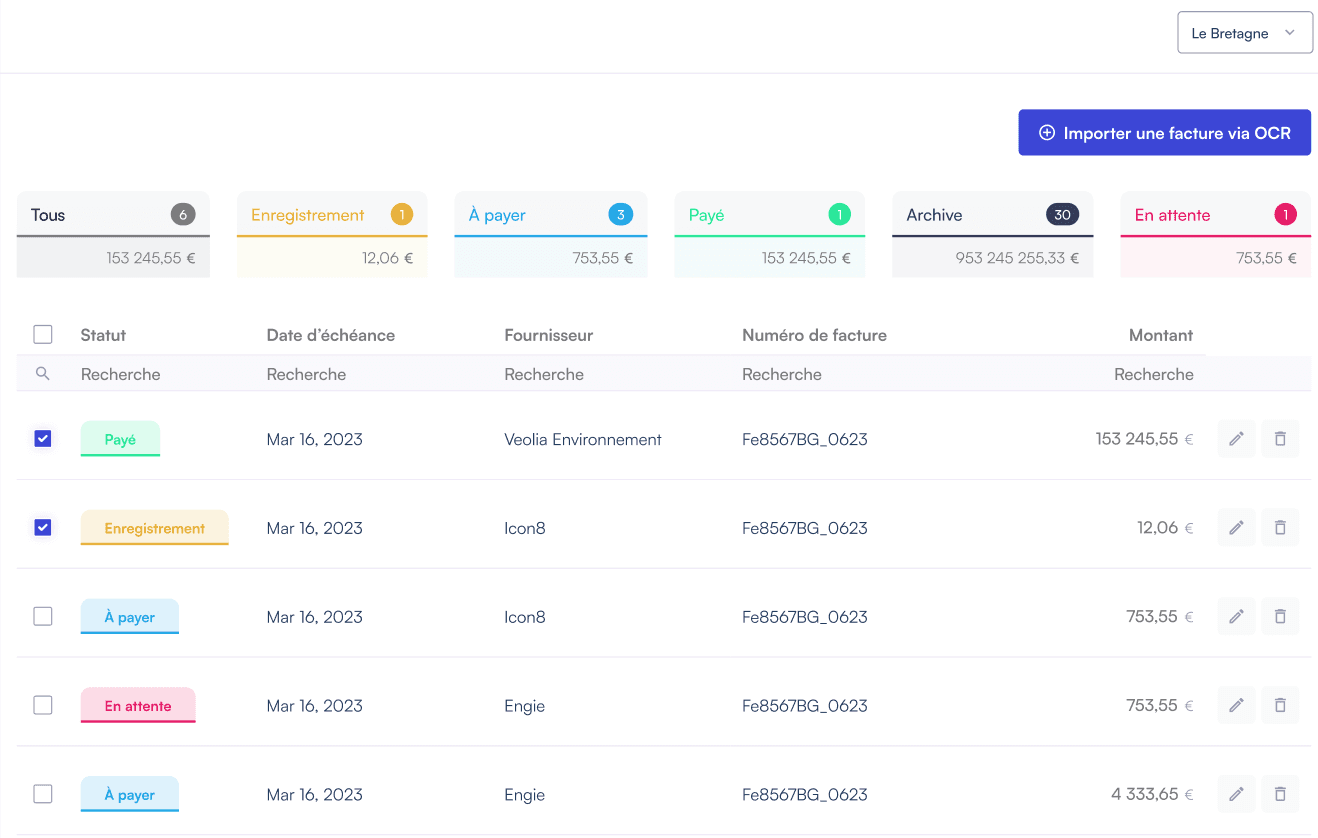
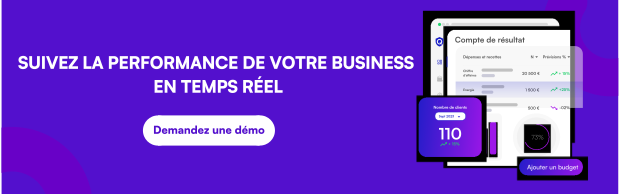
Companies have total visibility over all ongoing operations. SaaS solutions provide them with fully customizable dashboards that allow real-time tracking of payments made or to be made, current supplier debts, different invoices, and contractual agreements with different suppliers. This monitoring greatly facilitates decision-making as well as cash flow forecasting.
Supplier relationship management
Features allow for keeping communication channels with suppliers open, establishing transparent collaboration conditions, and strengthening strategic partnerships.
An example of a SaaS solution: Qotid
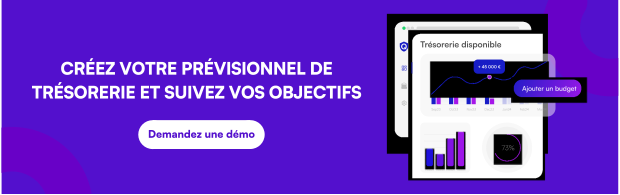
Qotid is the all-in-one solution that supports TPE/SME leaders and finance departments in their overall financial management. Equipped with multiple features in business intelligence, reporting creation, cash flow management, Qotid also offers functionalities in purchase management. Many resources are implemented to help leaders better manage their supplier invoices. It is a collaborative platform that improves communication between teams, establishes invoice validation circuits for more effective organization. Qotid also offers visibility and real-time monitoring of cash flow, enabling leaders to make the most effective possible decisions.
SaaS solutions are thus the answer for companies to enable effective accounts payable management. In addition to providing a perfectly automated solution that guarantees real-time monitoring and includes supplier relationship management functionalities, these SaaS solutions ensure the confidentiality of financial data, comply with constantly evolving regulations, and adapt perfectly to the needs of businesses due to their high technology.
Managing accounts payable is therefore a management task that deserves to be done well and not neglected as it has a direct impact on the company’s cash flow. Accounts payable plays an essential role in the company’s value chain, and its challenges represent a real lever that the company must exploit to optimize its cash flow effectively.
Ineffective management of this accounts payable could have consequences for the financial health of the company. To address these risks, companies have every interest in investing in a SaaS solution like Qotid, which offers functionalities in accounts payable management that aim to support them in this process.
In summary:
Managing accounts payable is a key element of a company's financial health. It involves managing relationships with suppliers, including contracts, payment terms, and debts to be paid.
Accounts payable plays a strategic role in the sustainability of the company by guaranteeing the fluidity of the supply chain and avoiding potential disputes. It is composed of various elements such as the number and diversity of suppliers, payment terms, negotiations, supplier debts, stock volume, and working capital.
Good management of accounts payable can enhance a company's financial resources, provide a reliable representation of actual cash flow, and preserve the business relationship with suppliers. Therefore, it is important to master negotiations with suppliers and regularly monitor the evolution of supplier debts to optimize cash flow.
F.A.Q:
Why is it important to master negotiations with suppliers?
It is important to master negotiations with suppliers to guarantee a reliable representation of the company's actual cash flow and preserve the business relationship with suppliers. Repeated and abusive negotiations or non-compliance with established deadlines can lead to a deterioration of the relationship with suppliers and an inability for the company to have a clear view of its actual cash flow.
What elements make up accounts payable?
Accounts payable is composed of various elements such as the number and diversity of suppliers, payment terms, negotiations, supplier debts, stock volume, and working capital. It represents how the company will manage its relationships with all its business partners on which it depends, whether for raw materials, products, or services.
How can good management of accounts payable favor a company’s financial resources?
Good management of accounts payable ensures the fluidity of the supply chain, avoids potential disputes, and preserves the business relationship with suppliers. This can translate into good communication, consistent quality of delivered products or performed services, increased reactivity to market fluctuations, negotiation opportunities, and favorable payment conditions. All these elements can contribute to optimizing cash flow and increasing the company’s financial resources.